|
Montefioralle
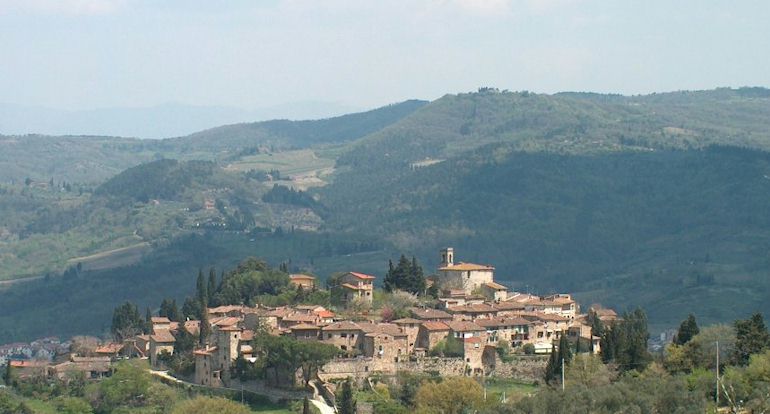
is rated one of the most beautiful villages in Italy
The village of Montefioralle is probably one of the most ancient in Chianti and is still today enclosed within its original walls. These were initially two circuits but houses now fill the space between the original structures. The walls were octagonal in outline, with four gates, modifications of which still exist. During the Middle Ages it was one of the largest military and administrative centres of the area. The first notice of the settlement is from 1085. It belonged to the families Ricasoli, Benci, Gherardini and Vespucci. In 1325 it was sacked by Castruccio Castracani.
At the highest point of the village, the church of S. Stefano, rebuilt in the 17 C and 18 C, may be visited. In the wide nave are a number of works of art, notably a precious work of the 13 C depicting the Virgin Mary with the baby Jesus and two angels, attributed to the Master of Bagnano or to the Maestro of Greve. In the presbytery is the "Trinity and four Saints", an anonymous work showing the influences of Neri di Bicci and Andrea del Castagno. On the left is a painting of the Virgin Mary with the John the Baptist and Saint Stephen, a work of the school of Lorenzo Monaco (beginning of the 15 C). Until 1630, the name of the village was Monteficalle. Since the 18 C, this fortified village has been overtaken in importance by Greve in Chianti, originally a simply local market.
Communal dinner, held once a year in Montefioralle
|
||||||||||||
Some of the sights at Montefioralle> > > Click the pictures for a larger view < < < |
||
)
Stormy sunrise over Montefioralle seen from Montefili |
)
An entry passage through the old outer wall |
)
Lion head horse hitch inside the main gate of Montefioralle |
)
An entry passage through the old outer wall |
)
The circular road inside Montefioralle |
)
The well below the walls towards Greve in Chianti |
)
A 19 C villa inside the site of the keep of Montefioralle |
)
One of the remaining towers of Montefioralle |
)
An entry lane at Montefioralle |
|
)
|
If
you are interested in castles - |
|
|
|
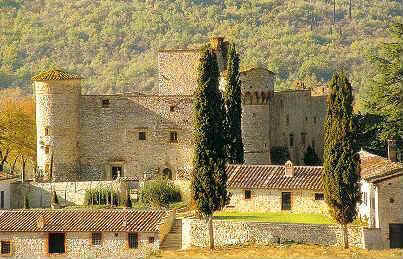
The Castle of Meleto is near Gaiole in Chianti, Italy. It was documented as early as the 11 C as a possession of the monks of nearby Coltibuono. More about Montefioralle |
Web hosting, web site design, content management, by ammonet
All original material, translations, images and coding Copyright © ammonet InfoTech 2005 - 2026. All rights reserved.


)
)
)